
This was not planned, but I see that the last wine I reviewed here was also a Pet Nat. That just happened. But that should be it on Pet Nats for the foreseeable future.
In the glass
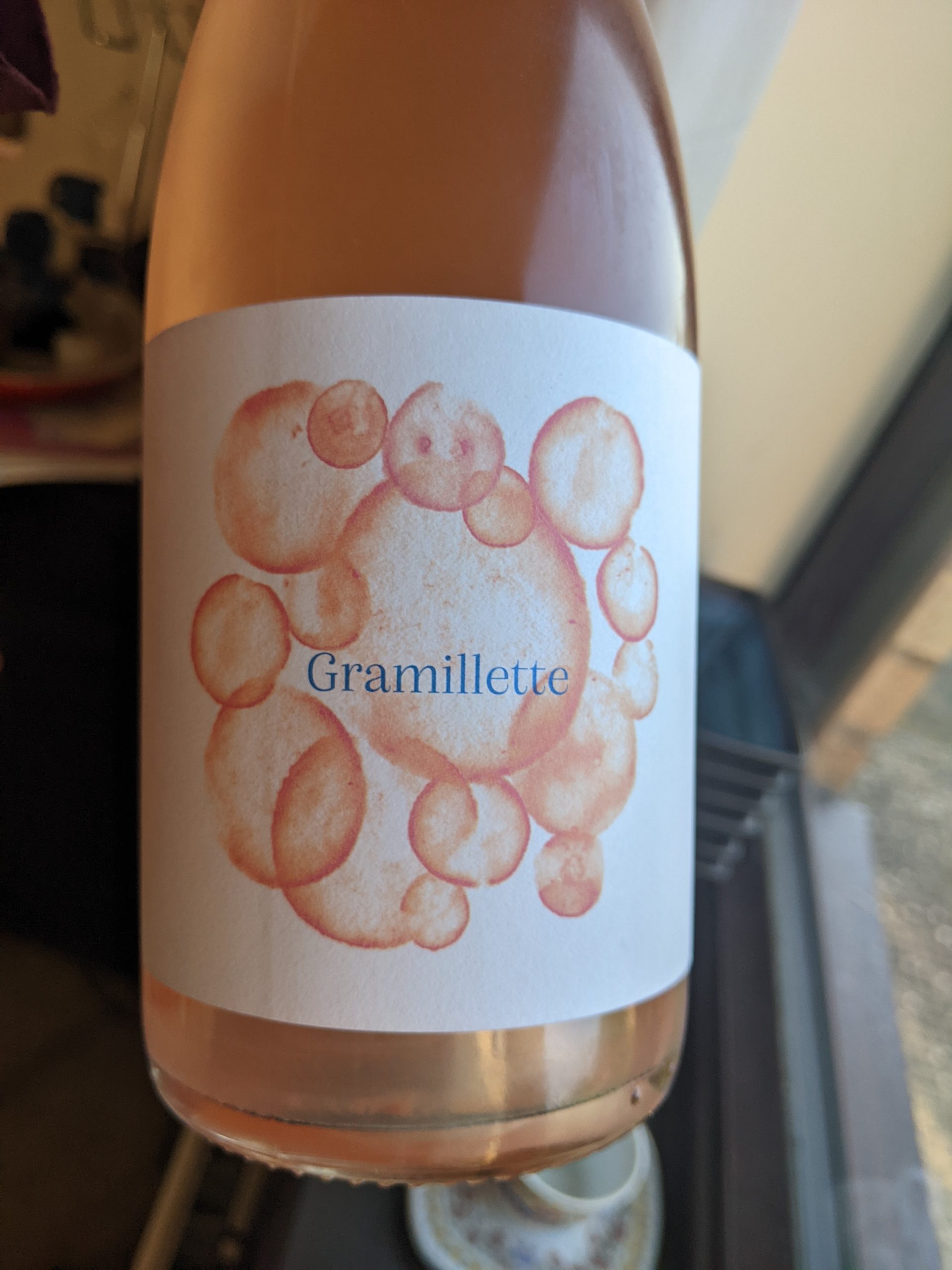
Before the glass, there’s the bottle. There’s a lot of sediment, and it’s cloudy. But given it is unfiltered, unfined and so forth, we’d expect that. It’s a very intriguing colour. I spent an inordinate amount of time trying to decide what to call it. I ended up with ‘faded peach,’ but I’m not sure I’m happy with that. But on to the glass.
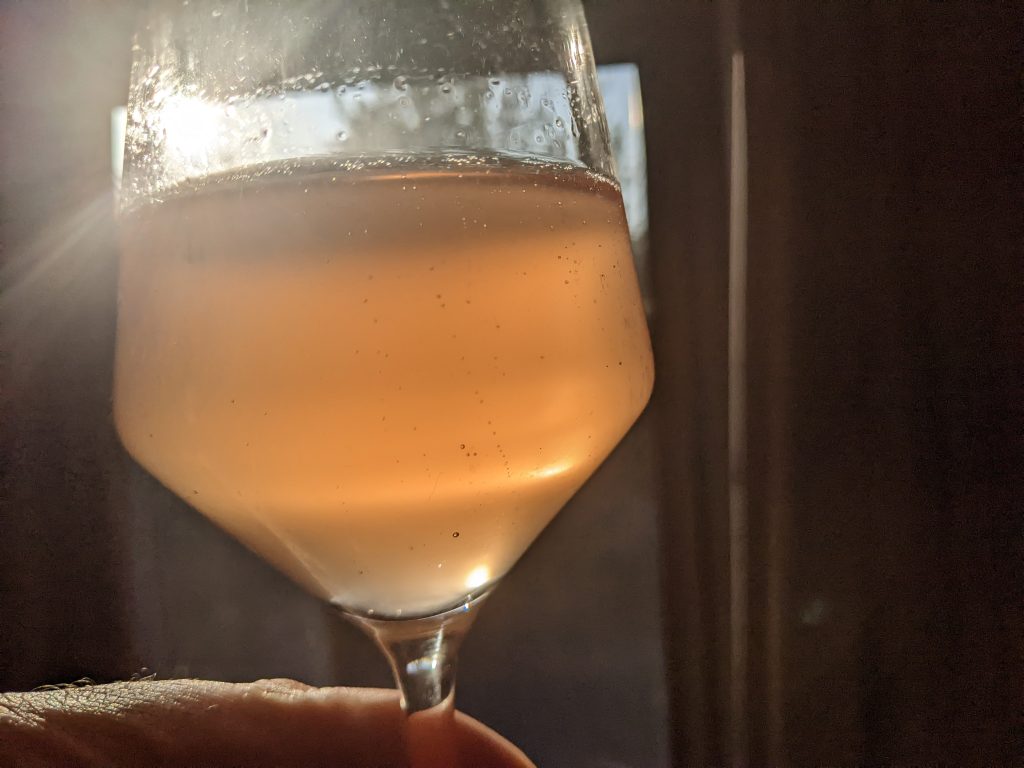
It’s cloudy, as I’ve noted. As I grappled how to describe it, I wrote that it isn’t really a rosé sort of pink, but maybe that’s down to the cloudiness. Perhaps if it was crystal clear, I’d say it looks like a rosé. Or perhaps not.
Imagine you had a favourite peach sweatshirt that faded after many, many washings. That’s the colour. I’m absolutely fascinated by the colour. (Yeah, maybe I do need to get a life.) I can’t call it ‘pretty’, but it is definitely very attractive.
The nose
The might be something there, but if there is, I couldn’t find it.
The palate
The first thing that strikes me is the petillance. Glad the wine lived up to its name. It’s ‘tingly.’ That’s not a word I often use to describe wine. Maybe I’ve never done so before. But this is the word that keeps popping into my head. The tingly-ness is a combination of the petillance and the acidity, which remains on the finish.
Oddly enough, I’m having a lot of trouble picking up individual tastes. Even when I can’t pick up anything on the nose, the palate comes through for me. There are tastes, but I’m finding it difficult to be more specific. Apples of some sort on the finish, which is quite long. Some red currants perhaps.
‘Muted red fruits’ is what my notes finally settled on.
There’s something else. Part of my brain wants to say ‘peach,’ but I’m sure that’s the influence of the colour. Apricots? Not really. Apparently the ‘peacotum’ exists in the world. This, or so a gardening website tells me, is across between a peach, an apricot and a plum. Perhaps that’s what I’m tasting. If not, I’ve learned a new word.
Aspirating the wine brings out more of the apple, and shifts it towards the red end of spectrum. I wouldn’t call the non-aspirated taste green apple, but it wasn’t a clearly defined red one either.
One thing is notable by omission. That’s the cider-y taste you get in many pet nats. I’m sure this will make newcomers to pet nats happy, as well as those with more traditional expectations than I have. But personally, I like that aspect, and miss it a bit here.
It’s refreshing, and zingy. It wouldn’t be out of place being drunk in the back garden out of a tumbler on a warm weekend afternoon.
Rating
Overall, a Yummy. I wanted to like this wine more, particularly given how intrigued I was by the colour. But in the end, it didn’t happen. There’s absolutely nothing wrong, but it just doesn’t excite me. I wouldn’t turn down a glass, but I’m not sure how quickly I’m going to go out and get another bottle.
Visually, it’s an Ooh… Shiny! I debated on this a bit. As I noted at the start, it’s not a pretty wine in the traditional sense. But I find it compelling.
Sustainability
Certified organic. Low-intervention in the winery. Largely organic / low-intervention in the vineyard, where their website says they use Bordeaux blend and sulphur when needed.
The technical info and such
10.5% ABV. 100% Clairette. £18.99 from Cambridge Wine Merchants.