That’s one more than Lynyrd Skynyrd asked for, which may or not be strictly relevant.
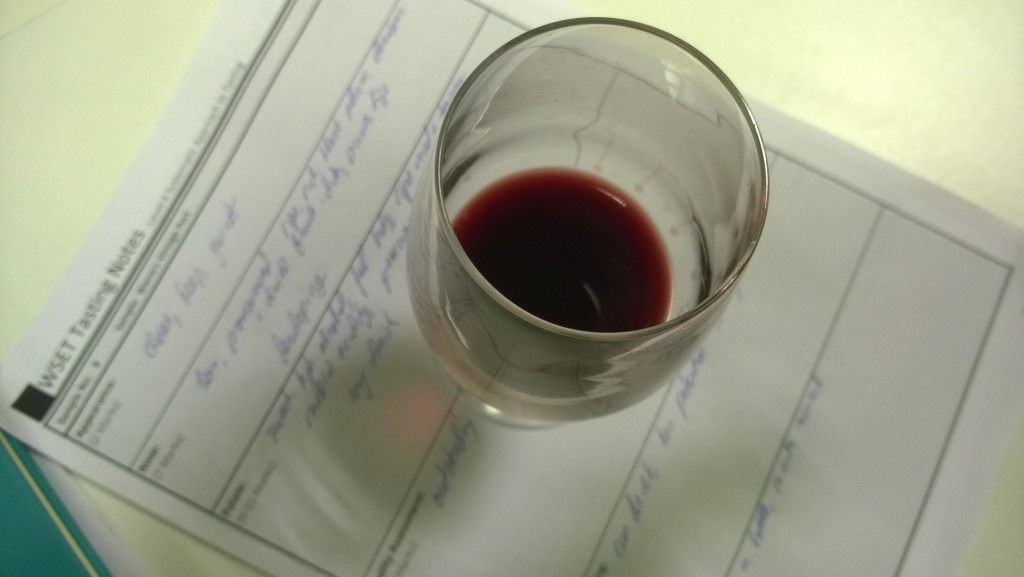
You may be familiar with the four steps of wine tasting. If you’ve ever gone to a tasting yourself, you’ll probably have been introduced to them. What you’ve probably never been told is that these steps – which date back to at least the nineteenth century – are for analytical tasting. It’s a procedure used for evaluating wine. Is it a technically well-made one, regardless of my personal preference? Is it a good representative of what it is, such as a Left Bank Bordeaux, or an Argentinian Malbec? How suitable for aging is it? In other words, it’s work. I’ve found too much of it takes away the enjoyment of the wine.
Nonetheless, it can be useful to think about different aspects of the wine separately, if for no other reason that it can help you stop and think about the various sensual aspects of wine. In other words, I think it is useful to know about the four steps but don’t feel the need to follow them religiously. So, let me give a quick overview of the steps.
Appearance
The first step is to evaluate the appearance. Three things are usually judged: clarity, depth of colour, and the colour itself. This can help if you are trying to identify a wine blind, and the industry wants their wines to be clear and bright, although you’ll see over the course of reviews this is really just a preference. Having said that, some wine can just be really pretty to look at. So take a gander.
Nose
That’s what we call the smell. Here the industry breaks the nose into primary, secondary and tertiary aromas, which result from the grape, the production methods, and age respectively. In addition, you are supposed to rate how prominent the aromas are. In an analytical tasting, you are supposed to come up with something like five different aromas, which can be difficult even if you have a good sense of smell. Imagine trying to find five terms to describe the smell of Poire William, a type of pear brandy. Read my thoughts on that here.
For this blog, well, I probably won’t have much to say on the nose.
Taste
This actually includes a whole lot of different things: The actual taste of the wine; the acidity and alcohol levels; the length of the finish; the body (how ‘big’ the wine feels). And so on. If you stop to think about it, there’s a lot crammed into this section, which also means each element doesn’t get the same level of recognition as the nose. That’s something I want to rectify here.
Evaluation
The last step is an evaluation. For most people, this is: Do I like it or not? For the wine trade, you will also probably need to consider quality versus price, ageing potential and more. Balance, length, intensity and complexity (BLIC) are the four things you are supposed to think about and evaluate here.